You are here:
Home/Uncategorized

Solar Beyond the Rooftop: Thin-Film, Floating and Marine Applications for Bangladesh

Bangladesh has no shortage of sunlight and a real shortage of places to put conventional solar panels. Land is scarce and expensive. Many industrial roofs were not designed to carry the weight of glass-framed modules. And a large share of the country’s economic activity happens on or beside water, where rigid panels are awkward to mount and unhappy in salt air.

What is thin-film solar, and where does it help?

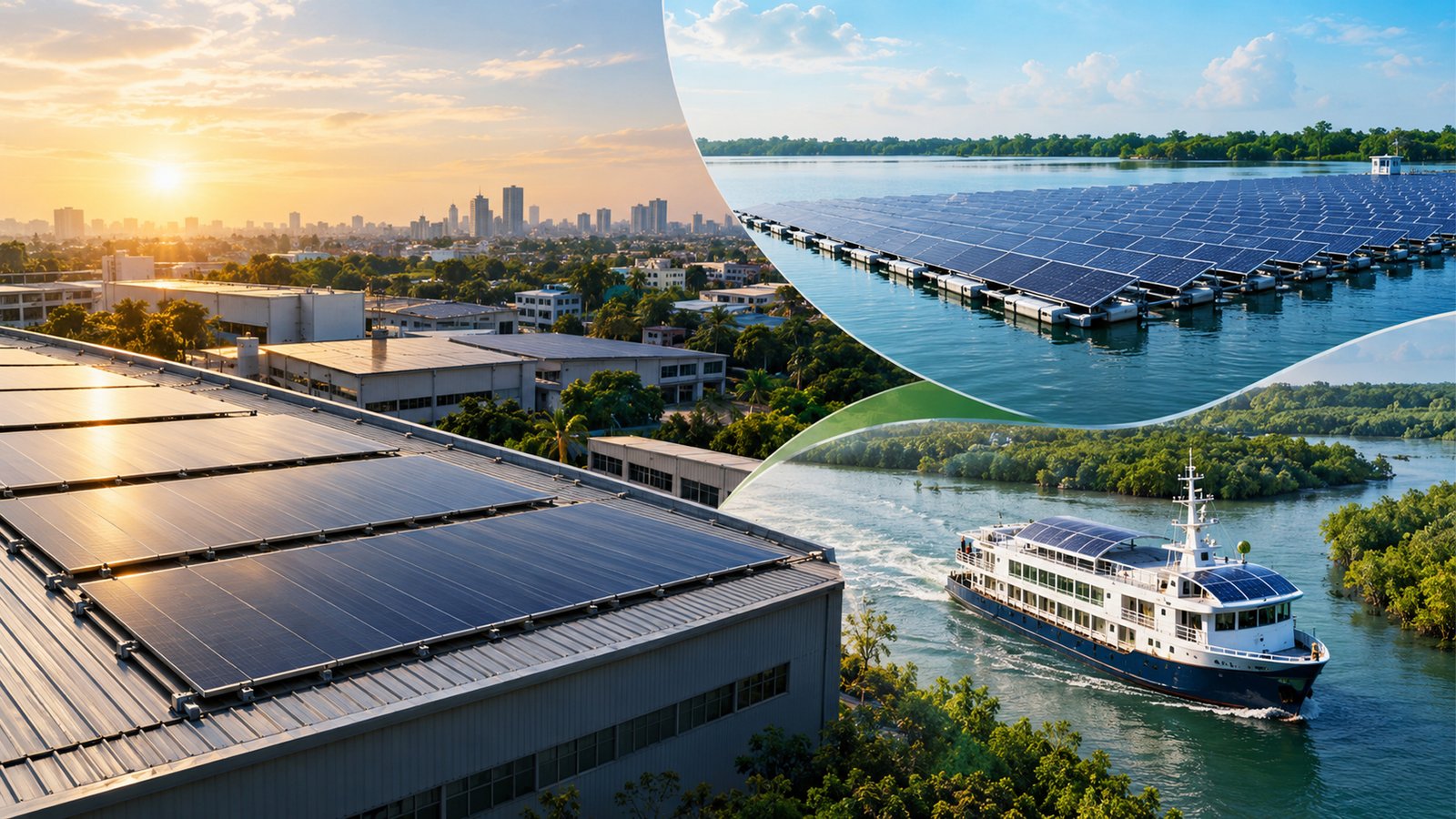
Thin-film solar uses very thin layers of photovoltaic material deposited on a flexible backing rather than cells mounted behind rigid glass. The practical consequence is weight and flexibility: thin-film modules are lighter per square metre and can follow curved or irregular surfaces. That opens up sites conventional panels rule out — older factory roofs with limited load capacity, lightweight structures, vehicle and vessel surfaces, and installations where the mounting frame would cost more than the panels.

Thin-film is not a universal replacement. Where you have strong roof structure, open space and a straightforward layout, conventional crystalline panels usually deliver more output per square metre for the money. The case for thin-film is site-driven, and it is strongest exactly where conventional equipment cannot go.

A working example on the water

In June 2026, Charm BD, the environmental and renewable energy arm of Unissol Group, signed a distribution and EPC partnership with Midsummer Siam, the regional arm of Swedish manufacturer Midsummer AB, to bring thin-film solar technology to Bangladesh. The agreement was signed aboard the M.V. Malangi, an eco-tourism vessel running on that technology, launched on 25 June at an event on building a sustainable future for the Sundarbans. The Swedish Ambassador to Bangladesh attended the launch.

A vessel serving one of the world’s most climate-vulnerable ecosystems is a demanding test case. It has no grid connection, limited deck area, weight constraints and a salt-air environment, and it operates somewhere diesel generators are least welcome.

Where this applies across Bangladesh

•    Commercial and industrial rooftops. Particularly older factory buildings where a structural assessment rules out conventional module weight.

•    Government facilities. Offices, institutions and public buildings with existing roof area and predictable daytime load.

•    Ports and maritime applications. Terminals, vessels and waterfront facilities where salt exposure and mounting constraints complicate standard installations.

•    Floating and near-water installations. Water bodies that cannot be built on but can carry floating arrays, reducing competition for land.

•    Climate resilience projects. Power for facilities in environmentally sensitive or grid-remote areas where fuel logistics are difficult.

What to check before you commit

Start with a structural load assessment of the roof, done by an engineer rather than estimated by a salesperson. Establish your actual daytime consumption profile, because solar economics depend on self-consumption far more than on installed capacity. Check the current net metering rules that apply to your connection and category — these have changed over time, so confirm them with your utility rather than relying on an older summary. Then look at what happens after commissioning: monitoring, cleaning, inverter servicing, warranty terms and who holds them locally.

Imported technology is only as good as the service behind it. Distribution and EPC capability in the same partnership matters because it means one organisation is answerable for both the equipment and the installation that carries its warranty.

FAQ

What is thin-film solar technology?

Thin-film solar uses thin photovoltaic layers on a flexible backing instead of cells behind rigid glass. The modules are lighter and can follow curved or irregular surfaces, which makes them suitable for roofs with limited load capacity, vessels and other sites where conventional panels are difficult to mount.

Is floating solar viable in Bangladesh?

It is one of the applications being explored, because floating arrays generate power without competing for scarce land. Viability depends on water body ownership, depth, seasonal variation, grid access and anchoring design, so each site needs its own assessment.

Can a factory roof in Bangladesh take solar panels?

Only if a structural assessment confirms it. Many older industrial roofs were not designed for the added weight of conventional glass modules, which is one reason lighter thin-film options are considered for these buildings.

Who supplies thin-film solar in Bangladesh?

Charm BD, part of Unissol Group, holds a distribution and EPC partnership with Midsummer Siam, the regional arm of Swedish manufacturer Midsummer AB, signed in June 2026.


Share this post?

About author

More posts

Leave A Reply

Your email address will not be published. Required fields are marked *

Mohammad Omar Faruk

Director

Got a Specific Question?

Talk to a specialist in your industry

Engr. Abul Hossain Khan Mamun

Director

Engr. Abul Hossain Khan Mamun, a seasoned civil engineer with over 32 years of experience, has significantly shaped Bangladesh’s construction landscape through his leadership and expertise in managing complex building projects. Starting his career at Borak Real Estate Ltd., he progressed from site engineer to project engineer, overseeing residential developments in Banani, Gulshan, and Baridhara, and later led landmark projects like the 27-storey Unique Acropolis and the prestigious Westin Dhaka as Project In-Charge. His roles as Deputy General Manager, Head of Construction, and Director of Construction saw him spearhead high-profile developments, including Hotel Sheraton Dhaka and Borak Mehnur.

Got a Specific Question?

Talk to a specialist in your industry

Major Khalid Mahmud, psc (Retd)

Director

With nearly 23 years of distinguished service in the Bangladesh Army, Mr Khalid has built extensive leadership experience across diverse operational, administrative and international roles. He has attended multiple advanced military professional courses and has represented Bangladesh abroad with excellence and integrity.


Mr Khalid brings a disciplined, results-driven and ethical approach to all professional responsibilities, making him a strong asset for any multifaceted business group.


Alongside his military career, Mr Khalid has pursued strong academic development in Business, Human Resource Management and Supply Chain Management. His combined expertise in strategic planning, logistics, operations management and organizational leadership enables him to add significant value to corporate environments.

Got a Specific Question?

Talk to a specialist in your industry

Ahmad Ullah

Director

Ahmad Ullah has been a well-known expert in color management and color processing systems in Bangladesh since 1994. At present, he is primarily involved in sustainability initiatives across both textile and non-textile sectors in Bangladesh.

Got a Specific Question?

Talk to a specialist in your industry

Jukka Hakola

Advisor

With over 30 years of professional experience in the international energy, water technology and industrial sectors, Mr Hakola has developed strong leadership expertise across strategic management, business development and global sales operations. Throughout his career, he has held several senior executive roles including COO, Vice President, Managing Director and Board Member in technology-driven organisations.


Mr Hakola has played an important role in transforming technical innovations into successful commercial products, building international sales networks and leading organisational development initiatives. His extensive experience in strategic planning, market analysis and operational leadership enables him to effectively support business growth in global markets.


With academic qualifications in both Engineering and Economics and a results-driven leadership approach, Mr Hakola brings valuable expertise in technology commercialisation, international business development and organisational management.

Got a Specific Question?

Talk to a specialist in your industry

Dr. Sven Salahuddin Hasse

Advisor

Dr. Sven Salahuddin Hasse is a Doctor of dental surgery graduated in Germany. After 20 years of serving in the health sector, he devoted himself to promote sustainable technologies in the textile industry. He has aquired extensive knowledge about heat recovery and air filtration. There’s a huge demand in the Bangladesh market from the environmental point of view. Surprisingly, the majority of factories are reluctant to use innovative, sustainable technology even though it would enhance their provit margin on the long run.

Got a Specific Question?

Talk to a specialist in your industry

Engr. Fazle Monayem

Advisor

Engr. M. Fazle Monayem, a Civil Engineering graduate from Rajshahi Engineering College (RUET) in 1990, has over three decades of experience in Bangladesh’s major infrastructure projects. He played key roles in the Jamuna and Padma Multipurpose Bridges, Dhaleswari Bridge, Dhaka MRT Line-06, and several national road development initiatives. He has also contributed to industrial projects with Square Pharmaceuticals, Meghna Group, and Abdul Monem Economic Zone, making a lasting impact on the country’s development sector.

Got a Specific Question?

Talk to a specialist in your industry

MD Ekram Ullah

Advisor

MD Ekram Ullah is a seasoned professional with extensive experience in sustainability-driven initiatives across both textile and non-textile sectors in Bangladesh. His work is focused on advancing responsible industrial practices that align environmental stewardship with long-term business performance.


With a strong emphasis on sustainable solutions, he is actively involved in projects related to environmental management, resource efficiency and infrastructure development. Through a strategic and results-oriented approach, MD Ekram Ullah continues to contribute to the adoption of practical, scalable and environmentally responsible systems that support Bangladesh’s sustainable industrial growth.

Got a Specific Question?

Talk to a specialist in your industry

Rui Owase

Advisor

Rui Owase is a wastewater treatment expert with over 20 years of experience in environmental solutions. As the Division Managing Director of Daiki Axis, he oversees operations across Bangladesh, Sri Lanka, Myanmar, and Indonesia, driving sustainable water management initiatives.


His vision aligns with Unissol Group to protect the environment and build a better future. He focuses on promoting clean water solutions and supporting eco-friendly development for long-term impact.

Got a Specific Question?

Talk to a specialist in your industry